
Author: DCAS

Who Are Essential Workers Who Can Be Tested for Coronavirus?

On the front lines of developing a test for the coronavirusAmong the Government’s list of those who can be tested are Essential Workers with symptoms, but who are these Essential Workers?

Here is the full list for England – please note that Payment Providers are included in the list

List of essential workers and those prioritised for testing (England only)

  • all NHS and social care staff, including:
    • doctors, nurses, midwives, paramedics, social workers, care workers, and other frontline health and social care staff including volunteers
    • the support and specialist staff required to maintain the UK’s health and social care sector
    • those working as part of the health and social care supply chain, including producers and distributors of medicines, and medical and personal protective equipment
    • NHS Blood and Transplant frontline staff (blood donation staff, specialist nurses for organ donation, staff running therapeutic apheresis services in NHS hospitals)
    • those providing ancillary support to NHS workers (such as hotel accommodation for NHS staff)
  • essential public services staff, including:
    • prisons, probation, courts and tribunals staff, judiciary
    • religious staff
    • charities and workers delivering critical frontline services
    • those responsible for the management of the deceased
    • journalists and broadcasters covering coronavirus or providing public service broadcasting
    • public health and environmental staff, such as specialist community public health nursing
  • public safety and national security staff, including:
    • police and support staff
    • Ministry of Defence civilians, contractors and armed forces personnel (those critical to the delivery of critical defence and national security outputs and critical to the response to the coronavirus pandemic), including defence medical staff
    • fire and rescue service employees (including support staff),
    • National Crime Agency staff, those maintaining border security, prison and probation staff and other national security roles, including those overseas
    • British Transport Police and the Maritime and Coastguard Agency
  • transport workers, including:
    • those who keep the air, water, road and rail passenger and freight transport modes operating during the coronavirus response
    • those working on transport systems through which supply chains pass
  • education and childcare workers, including:
    • support and teaching staff
    • social workers
    • specialist education professionals
  • critical personnel in the production and distribution of food, drink and essential goods, including:
    • those involved in food production, processing, distribution, sale and delivery
    • those critical to the provision of other essential goods, such as medical supply chain and distribution workers, including community pharmacy and testing (such as PHE labs), and veterinary medicine
    • workers critical to the continuity of essential movement of goods
  • local and national government staff critical to the effective delivery of the coronavirus response, or delivering essential public services, such as the payment of benefits
  • public and environmental health staff, including in government agencies and arm’s length bodies
  • funeral industry workers
  • frontline local authority staff and volunteers, including
    • those working with vulnerable children and adults, victims of domestic abuse, and the homeless and rough sleepers (and hotel staff supporting these groups)
    • voluntary sector organisations providing substance misuse treatment
  • utilities, communication and financial services staff, including:
    • staff needed for essential financial services provision (including but not limited to workers in banks, building societies and financial market infrastructure)
    • the oil, gas, electricity and water sectors (including sewerage)
    • information technology and data infrastructure sector and primary industry supplies to continue during the coronavirus response
    • essential staff working in the civil nuclear, chemicals, telecommunications (including but not limited to network operations, field engineering, call centre staff, IT and data infrastructure, 999 and 111 essential services), postal services and delivery, payments providers and waste disposal sectors

ACAS Advice on Lay-offs, Short-time Working and Using Holidays

Lay-offs and short-time working

In some situations, an employer might need to close down their business for a short time, or ask staff to reduce their contracted hours.

If the employer thinks they’ll need to do this, it’s important to talk with staff as early as possible and throughout the closure.

Unless it says in the contract or is agreed otherwise, they still need to pay their employees for this time.

Employees who are laid off and are not entitled to their usual pay might be entitled to a ‘statutory guarantee payment’ of up to £30 a day from their employer.

This is limited to a maximum of 5 days in any period of 3 months. On days when a guarantee payment is not payable, employees might be able to claim Jobseeker’s Allowance from Jobcentre Plus.

Find out more about:

Using holiday for a temporary workplace closure

Employers have the right to tell employees and workers when to take holiday if they need to.  An employer could, for example, shut for a week and tell everyone to use their holiday entitlement.

Find out more about using holiday.

The Coronavirus Job Retention Scheme

Coronavirus Job Retention Scheme: an update from HMRC | Cambridge ...Claim for your employees’ wages through the Coronavirus Job Retention Scheme
If you’ve had to dismiss staff because of coronavirus (COVID-19), you might be able to re-employ them and pay their wages through the Coronavirus Job Retention Scheme

Who can claim

You must have:

  • created and started a PAYE payroll scheme on or before 28 February 2020
  • enrolled for PAYE online – this can take up to 10 days
  • a UK bank account

Any entity with a UK payroll can apply, including businesses, charities, recruitment agencies and public authorities.

For more information on Apprentices, click here

Employees you can claim for

You can only claim for furloughed employees that were on your PAYE payroll on or before 28 February 2020.

To claim, you will need:

  • your ePAYE reference number
  • the number of employees being furloughed
  • the claim period (start and end date)
  • amount claimed (per the minimum length of furloughing of 3 consecutive weeks)
  • your bank account number and sort code
  • your contact name
  • your phone number

You will need to calculate the amount you are claiming. HMRC will retain the right to retrospectively audit all aspects of your claim.

If you made employees redundant or they stopped working for you after 28 February

If you made employees redundant, or they stopped working for you on or after 28 February 2020, you can re-employ them, put them on furlough and claim for their wages through the scheme.

If your employee is on maternity leave, adoption leave, paternity leave or shared parental leave

The normal rules for maternity and other forms of parental leave and pay apply.

You can claim through the scheme for enhanced (earnings related) contractual pay for employees who qualify for either:

  • maternity pay
  • adoption pay
  • paternity pay
  • shared parental pay

Some of the rules are quite complicated, so more information can be found here 

Dismissing staff

Dismissal is when you end an employee’s contract. When dismissing staff, you must do it fairly.

There are different types of dismissal:

  • fair dismissal
  • unfair dismissal
  • constructive dismissal
  • wrongful dismissal

Fair and unfair dismissal

A dismissal is fair or unfair depending on:

  • your reason for it
  • how you act during the dismissal process

Constructive dismissal

This is when an employee resigns because you’ve breached their employment contract. This could be a single serious event or a series of less serious events.

An employee could claim constructive dismissal if you:

  • cut their wages without agreement
  • unlawfully demote them
  • allow them to be harassed, bullied or discriminated against
  • unfairly increase their workload
  • change the location of their workplace at short notice
  • make them work in dangerous conditions

A constructive dismissal is not necessarily unfair – but it would be difficult for you to show that a breach of contract was fair.

A constructive dismissal might lead to a claim for wrongful dismissal.

Wrongful dismissal

This is where you break the terms of an employee’s contract in the dismissal process, for example dismissing someone without giving them proper notice.

Wrongful dismissal is not the same as unfair dismissal.

If an employee thinks you’ve dismissed them unfairly, constructively or wrongfully, they might take you to an employment tribunal.

More details can be found here

COVID-19 Support for Self-Employed

Chancellor announces additional measures to help businesses and the self-employed impacted by COVID-19

The Chancellor announced a major package of support for the self-employed:

  • HMG will pay the self-employed a taxable grant worth 80% of their average monthly profits over the last three years up to £2500 per month
  • This will be available for three months. Will be extended if necessary
  • People can claim these grants and continue to do business
  • Covers self-employed same as those furloughed

To ensure the funds reaches the people most in need:

  • Open to anyone of trading profits of up to £50,000
  • Available to people who i) make the majority of their income being self-employed, ii) Have a self-employed tax return for 2019

How to access

  • HMRC will contact you directly and you’ll have to fill out a form
  • HMRC will pay the grant directly to bank accounts.
  • Aim is to pay at the beginning of June (3 months backdated). Hoping to be quicker than that but recognition HMRC are now having to design two new systems
  • Anyone who missed the Jan filing deadline has an extra 4 weeks from today to submit their tax return

Further Details can be found at – https://www.gov.uk/government/news/chancellor-gives-support-to-millions-of-self-employed-individuals

Guidance for Employers and Businesses on Coronavirus (COVID-19)

What you need to know

  • businesses and workplaces should encourage their employees to work at home, wherever possible
  • if someone becomes unwell in the workplace with a new, continuous cough or a high temperature, they should be sent home and advised to follow the advice to stay at home
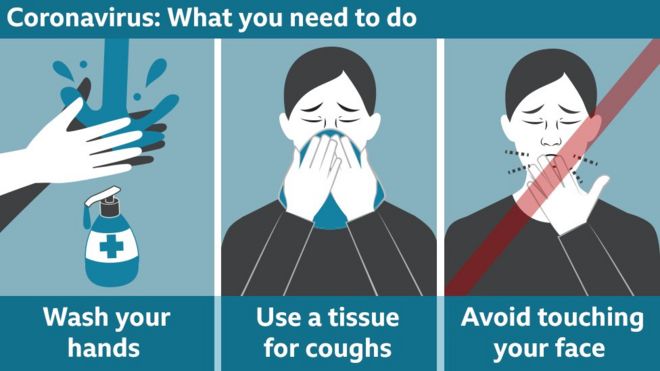
  • employees should be reminded to wash their hands for 20 seconds more frequently and catch coughs and sneezes in tissues
  • frequently clean and disinfect objects and surfaces that are touched regularly, using your standard cleaning products
  • employees will need your support to adhere to the recommendation to stay at home to reduce the spread of coronavirus (COVID-19) to others
  • those who follow advice to stay at home will be eligible for statutory sick pay (SSP) from the first day of their absence from work
  • employers should use their discretion concerning the need for medical evidence for certification for employees who are unwell. This will allow GPs to focus on their patients
  • if evidence is required by an employer, those with symptoms of coronavirus can get an isolation note from NHS 111 online, and those who live with someone that has symptoms can get a note from the NHS website
  • employees from defined vulnerable groups should be strongly advised and supported to stay at home and work from there if possible

The full document can be found here

Coronavirus and Sick Pay

Coronavirus graphic on what you need to doWe have been asked for clarification on Sick Pay during the Coronavirus, so here is the official Government advice

Sick pay

Those who follow advice to stay at home and who cannot work as a result will be eligible for statutory sick pay (SSP), even if they are not themselves sick.

Employers should use their discretion and respect the medical need to self-isolate in making decisions about sick pay.

Anyone not eligible to receive sick pay, including those earning less than an average of £118 per week, some of those working in the gig economy, or self-employed people, is able to claim Universal Credit and or contributory Employment and Support Allowance.

For those on a low income and already claiming Universal Credit, it is designed to automatically adjust depending on people’s earnings or other income. However, if someone needs money urgently they can apply for an advance through the journal.

Certifying absence from work

By law, medical evidence is not required for the first 7 days of sickness. After 7 days, employers may use their discretion around the need for medical evidence if an employee is staying at home.

We strongly suggest that employers use their discretion around the need for medical evidence for a period of absence where an employee is advised to stay at home either as they are unwell themselves, or live with someone who is, in accordance with the public health advice issued by the government.

More details are available by clicking here

Advice for Employers is available from ACAS

Working from home

For any employee working from home, the employer should:

  • pay the employee as usual
  • keep in regular contact
  • check on the employee’s health and wellbeing

Find out more about:

If evidence is required to cover self-isolation or household isolation beyond the first 7 days of absence then employees can get an isolation note from NHS 111 online or from the NHS website.

More advice from ACAS can be found by clicking here

Coronavirus (COVID-19) Guidance for Employers, and Social Distancing Advice

Image result for coronavirusIn these very uncertain times, we thought it prudent to direct you to a few documents which are very clear, detailed and helpful for both Employers and Employees regarding Coronavirus (COVID -19)

Guidance from ACAS on the Coronavirus can be found here – this gives very clear advice for both employers and employees, and answers some difficult questions regarding sick pay, working from home and social distancing

Guidance for Employers –  this guidance from the government is updated daily, and can be found here 

Guidance on Social Distancing – can be found  here – this gives more detail of the groups who are at increased risk of severe illness from Coronavirus, and explains Social Distancing in more detail

TUPE

Image result for Transfer of Undertaking TUPETUPE

TUPE stands for the Transfer of Undertakings (Protection of Employment) Regulations

The TUPE rules apply to organisations of all sizes and protect employees’ rights when the organisation or service they work for transfers to a new employer.

TUPE has impacts for the employer who is making the transfer (also known as the outgoing employer or the transferor) and the employer who is taking on the transfer (also known as the incoming employer, the ‘new employer’ or the transferee).

When does TUPE apply?

There are two situations when the TUPE regulations may apply; business transfers and service provision transfers.

In business transfers

The TUPE regulations apply if a business or part of a business moves to a new owner or merges with another business to make a brand new employer.

In service provision transfers

The TUPE regulations apply in the following situations:

  • a contractor takes over activities from a client (known as outsourcing).
  • a new contractor takes over activities from another contractor (known as re-tendering).
  • a client takes over activities from a contractor (known as in sourcing).

 ACAS had produced a short introductory video to explain TUPE which you can find here

Terms and conditions under TUPE

When TUPE applies, the employees of the outgoing employer automatically become employees of the incoming employer at the point of transfer. They carry with them their continuous service from the outgoing employer, and should continue to enjoy the same terms and conditions of employment with the incoming employer.

Following a transfer, employers often find they have employees with different terms and conditions working alongside each other and wish to change/harmonise terms and conditions. However, TUPE protects against change/harmonisation for an indefinite period if the sole or principal reason for the change is the transfer. Any such changes will be void.

More detailed information can be found here

Eligibility for Statutory Sick Pay

Sick Leave | HR SolutionsYou can get £94.25 per week Statutory Sick Pay (SSP) if you’re too ill to work. It’s paid by your employer for up to 28 weeks.

You need to qualify for SSP and have been off work sick for 4 or more days in a row (including non-working days).

You cannot get less than the statutory amount. You can get more if your company has a sick pay scheme (or ‘occupational scheme’) – check your employment contract.

Eligibility

To qualify for Statutory Sick Pay (SSP) you must:

  • be classed as an employee and have done some work for your employer
  • have been ill for at least 4 days in a row (including non-working days)
  • earn an average of at least £118 per week
  • tell your employer you’re sick before their deadline – or within 7 days if they do not have one

Agency workers are entitled to Statutory Sick Pay.

Exceptions

You will not qualify if you:

  • have received the maximum amount of SSP (28 weeks)
  • are getting Statutory Maternity Pay

You can still qualify if you started your job recently and you have not received 8 weeks’ pay yet. Ask your employer to find out more.

Linked periods of sickness

If you have regular periods of sickness, they may count as ‘linked’. To be linked, the periods must:

  • last 4 or more days each
  • be 8 weeks or less apart

You’re no longer eligible for SSP if you have a continuous series of linked periods that lasts more than 3 years.

Fit notes (or sick notes)

You only have to give your employer a fit note if you’re off sick for more than 7 days in a row (including non-working days).

You can get a fit note from your GP or hospital doctor. If your employer agrees, a similar document can be provided by a physiotherapist, podiatrist or occupational therapist instead. This is called an Allied Health Professional (AHP) Health and Work Report.

If you’re not eligible or your SSP ends

You may be able to apply for Universal Credit or Employment and Support Allowance (ESA). You can use form SSP1 to support your application.

If your SSP is ending your employer must send you form SSP1 either:

  • within 7 days of your SSP ending, if it ends unexpectedly while you’re still sick
  • on or before the beginning of the 23rd week, if your SSP is expected to end before your sickness does

If you do not qualify for SSP your employer must send you form SSP1 within 7 days of you going off sick.

Employers can find Form SSP1 here