Author: DCAS

Insolvency and Redundancy Payments

Insolvent jpegPreviously, if your employer became insolvent, and you were therefore made redundant, you used to have to go to an employment tribunal to claim all redundancy payments, but now you can apply direct to the government’s  Insolvency Service for the money that you are owed.

How to claim for redundancy and other money you’re owed by an employer

To apply, you must complete the online application. The Insolvency Service will then assess your claim and pay you the money you’re entitled to.

Separate payments are made for different parts of your claim, such as redundancy pay, holiday pay and arrears of pay. You will then be sent a letter each time that the Insolvency Service makes a payment. This means that you may get several different letters from the Insolvency Service.

Further Government Guidance

If you were made redundant on or after 6 April 2021, your weekly pay is capped at £544. If you were made redundant before 6 April 2021, these amounts will be lower. This means if your gross weekly pay was more than this, we have capped each one of your payments.

If you are owed more than the maximum we can pay, you can register as a creditor in the insolvency for any outstanding money you’re owed.

Further details can be found here

Employment Contracts

Employment Contract jpegAll employees have an employment contract with their employer. A contract is an agreement that sets out an employee’s:

  • employment conditions
  • rights
  • responsibilities
  • duties

These are called the ‘terms’ of the contract.

Employees and employers must stick to a contract until it ends (for example, by an employer or employee giving notice or an employee being dismissed) or until the terms are changed (usually by agreement between the employee and employer).

Accepting a contract

As soon as someone accepts a job offer they have a contract with their employer. An employment contract does not have to be written down.

A contract between an employer and an employee or worker is a legally binding agreement. This could be a ‘contract of employment’ or a ‘contract of service’.

A contract can be agreed verbally or in writing.

What an employer must provide in writing

Anyone legally classed as an employee or worker has the right to a written document summarising the main terms of their employment.

Those legally classed as workers do not have the right to written terms if they started the job before 6 April 2020.

The legal term for this document is the ‘written statement of employment particulars’. It includes information such as pay and working hours.

This document is often referred to as the ’employment contract’. But by law, the employment contract is broader than just these written terms – for example, employment law is also part of an employee’s contract but usually the law will not be written in full in the document.

Contract terms

The legal parts of a contract are known as ‘terms’. An employer should make clear which parts of a contract are legally binding (for example, an employer must pay employees at least the National Minimum Wage)

More detailed information can be found here on the ACAS site, and here on the Government website

Shared Parental Leave and Pay

Parents and children jpegHow it works

You and your partner may be able to get Shared Parental Leave (SPL) and Statutory Shared Parental Pay (ShPP) if you’re:

  • having a baby
  • using a surrogate to have a baby
  • adopting a child

You can share up to 50 weeks of leave and up to 37 weeks of pay between you.

You need to share the pay and leave in the first year after your child is born or placed with your family.

You can use SPL to take leave in blocks separated by periods of work, or take it all in one go. You can also choose to be off work together or to stagger the leave and pay.

To get SPL and ShPP, you and your partner need to:

Eligibility for birth parents

To be eligible for Shared Parental Leave (SPL) and Statutory Shared Parental Pay (ShPP), both parents must:

  • share responsibility for the child at birth
  • meet work and pay criteria – these are different depending on which parent wants to use the shared parental leave and pay

You’re not eligible if you started sharing responsibility for the child after it was born.

More details and information can be found here

Paying an employee after giving them a P45

You need to tell HM Revenue and Customs (HMRC) when one of your employees leaves or retires, and deduct and pay the right tax and National Insurance.

You must give your employee a P45 when they leave.

Paying an employee after giving them a P45

If you have to pay an employee after they leave (including someone you’re giving a taxable redundancy payment over £30,000):

  • use tax code 0T on a ‘week 1’ or ‘month 1’ basis (use the code S0T if they’re taxed at the Scottish rate or C0T if they’re taxed at the Welsh rate)
  • deduct National Insurance (unless it’s a redundancy payment) and any student loan repayments as normal – but if it’s an ‘irregular’ payment like accrued holiday pay or an unexpected bonus, treat it as a weekly payment
  • report the payment and deductions in your next FPS, using the employee’s original ‘Date of leaving’ and payroll ID, and set the ‘Payment after leaving’ indicator
  • give the employee written confirmation of the payment showing the gross amount and deductions
  • add the additional payment in the ‘Year to date’ field if the payment is in the same tax year

The payment should be the only one in the ‘Year to date’ field if it’s being paid in the next tax year.

You must not give the employee another P45

Keeping Up To Date

checklistWe’ve put together a checklist for you to help you to keep up to date with all your responsibilities. Hope you will find it useful!  Don’t forget that we are here to guide you through if you need any help!

Have you:

  • filed your Charity Commission Annual Return?
  • had your annual accounts examined?

If you are a charitable company, have you –

  • filed your annual accounts with Companies House?
  • checked when you should complete your Companies House annual return?
  • NO REMINDERS ARE SENT OUT THESE DAYS!
Have you:
  • registered with the Information Commissioner’s Office re Data Protection Fees?
  • checked when your insurance is up for renewal?
  • planned how to continue delivering services under conditions of COVID?
  • established working from home procedures, and will you need to change contracts of employment?
  • thought about how you will recruit new trustees and hold meetings?
  • started preparing your annual budget? If you need any help, do contact DCAS
 …..and finally – don’t forget to feel a sense of pride for all the work your charity does, and the important role charities play in the life of Derby!

Safeguarding and protecting people

Charity Commission LogoProtecting people and safeguarding responsibilities should be a governance priority for all charities. It is a fundamental part of operating as a charity for the public benefit.

As part of fulfilling your trustee duties, whether working online or in person, you must take reasonable steps to protect from harm people who come into contact with your charity.

This includes:

  • people who benefit from your charity’s work
  • staff
  • volunteers
  • other people who come into contact with your charity through its work

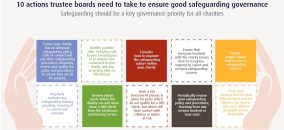
10 actions trustee boards need to take to ensure good safeguarding governance

Click on the picture below

10 Actions Safeguarding

More detailed information and advice can be found here

Flexible Working

flexible workingFlexible working is a way of working that suits an employee’s needs, for example, you may want to
  • reduce your hours to work part-time
  • change your start and finish time
  • have flexibility with your start and finish time (sometimes known as ‘flexitime’)
  • do your hours over fewer days (‘compressed hours’)
  • work from home or elsewhere (‘remote working’), all or part of the time
  • share the job with someone else

All employees have the legal right to request flexible working – not just parents and carers.

This is known asmaking a statutory application’.

Employees must have worked for the same employer for at least 26 weeks to be eligible.

If this is of interest to you, and you want to find out more, ACAS have really helpful advice here

Ted Cassidy Memorial Award Winners

BF220EC6-DB93-4C67-B884-ED172A65A0BFSadly, Derby Community Accountancy Service lost our Honorary President, Ted Cassidy, in January 2021.

In memory of Ted, and to celebrate the great contribution he made to DCAS and our service users, it was decided to reward a local charity for playing their part in bettering the lives of the people of Derby.

We are pleased to announce that the winners of the Ted Cassidy Memorial Award 2021 for the outstanding contribution given by a charity to life in Derby, goes to Derby Refugee Forum.

Ferid Kevric is pictured here receiving the certificate on their behalf at our AGM last month. They also received a cheque from Mrs Una Cassidy.

Many congratulations to Derby Refugee Forum!