Tag: business

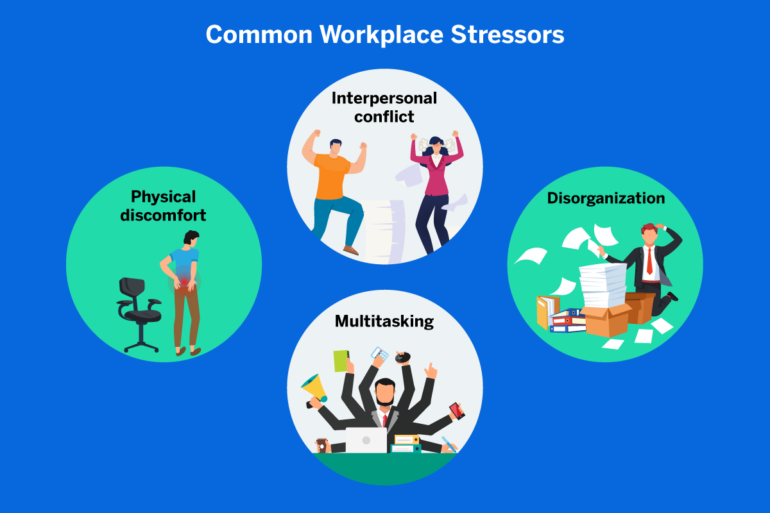
Managing Work-Related Stress

There are 2 main pieces of health and safety law which cover work-related stress:

  • the Health and Safety at Work Act 1974 – this puts a ‘duty of care’ on employers to protect their employees from the risk of stress at work
  • the Management of Health and Safety at Work Regulations 1999 – this requires all employers to make a ‘suitable and sufficient assessment’ of the risks to the health and safety of their employees at work

This means that by law employers must:

  • identify any risks to their employees’ health, for example by carrying out a risk assessment
  • take steps to prevent or reduce work-related stress 

Stress is defined by the Health and Safety Executive (HSE) as ‘the adverse reaction people have to excessive pressures or other types of demand placed on them’.

Some people benefit from a certain amount of pressure as it can keep them motivated. However, when there is too much pressure it can lead to stress.

Stress is not an illness but it can affect a person’s physical and mental health.

If not properly managed, stress can cause:

  • ‘burnout’ (physical and emotional exhaustion)
  • anxiety
  • depression

Stress can increase the risk of physical illnesses. For example:

  • heart disease
  • back pain
  • digestive conditions like irritable bowel syndrome
  • skin conditions

Spotting the signs of stress

Employees should look after their own health and wellbeing at work. If they are experiencing stress, they should talk to their manager as soon as they can. Managers should also look out for any signs of stress among their employees.

Signs of stress can include:

  • poor concentration
  • finding it hard to make decisions
  • being irritable or short tempered
  • tearfulness
  • tiredness
  • low mood
  • avoiding social events

If an employer or employee spots signs of stress, it can be helpful to have an informal chat. This can help them understand how the person is feeling and what support they need. Getting help could prevent more serious problems.

Managers could encourage their employees to do a ‘Wellness Action Plan’. This can help them to:

  • think about what’s causing them stress
  • talk to their manager and get the support they need

Use a Wellness Action Plan from Mind

More detailed information from ACAS can be found here

Holiday Entitlement – How Much Holiday Someone Gets

Employees have the right to ‘statutory annual leave’ (paid holiday).

This is the case whether they work:

  • full time
  • part time
  • under a zero-hours contract

The number of days’ holiday someone gets depends on:

  • how many days or hours they work
  • any extra agreements they have with their employer

Employees ‘accrue’ (build up) holiday from the day they start working, including when they’re on:

  • a probationary period
  • sick leave
  • maternity, paternity, adoption or shared parental leave

When to ask for holiday

Employees should ask for their holiday dates as far in advance as possible, This is so the employer can make any arrangements needed.

Employees should ask for holiday at least twice the amount of time beforehand as the amount they want to take off. For example if an employee wants 10 days off they’ll need to ask at least 20 days before.

This is unless their employment contract says they must give more notice.

When to take holiday by

An employer can set a fixed start and end date for when employees should take their holiday entitlement in each year. This is called the ‘leave year’.

If an employer has set a leave year, they should:

  • tell employees
  • write it in the contract terms or another agreement document

For example, an employer might set the leave year to start and end alongside the financial year – 1 April to 31 March each year.

If an employer has not set a leave year, it begins from the day the employee started working for the organisation.

Employees should take their statutory 5.6 weeks’ holiday entitlement during the leave year.

In some circumstances, employees can carry over their holiday into the next leave year. Find out more about carrying over holiday.

Holiday when leaving a job

During their notice period, an employee might be able to take any holiday they have accrued.

This will depend on whether:

  • they can give the right amount of notice to ask for holiday
  • their employer lets them take the holiday

Alternatively, the employer might ask the employee to take the holiday before they leave.

How much holiday an employee has depends on how far through the leave year they end the job.

If an employee has any holiday entitlement left when they leave, their employer must add this holiday pay to their final pay. This is sometimes called ‘payment in lieu’ of taking holiday.

An employee might have taken more holiday than their entitlement by the time their job ends. In this situation, the employer can take money from their final pay. This must be agreed beforehand in writing. This is sometimes known as a ‘payback clause’.

Contact the Acas helpline

If you have any questions about holiday entitlement, you can contact the Acas helpline.

Holiday Pay and Entitlement

The government has introduced reforms to simplify holiday entitlement and holiday pay calculations in the Working Time Regulations.

Definition of an irregular hour worker and a part-year worker

How a worker is classified will depend on the precise nature of their working arrangements. We would encourage employers to ensure that working patterns are clear in their workers’ contracts.

The government has defined irregular and part-year as the following:

Irregular hours workers

A worker is an irregular hours worker, in relation to a leave year, if the number of paid hours that they will work in each pay period during the term of their contract in that year is, under the terms of their contract, wholly or mostly variable.

Part-year workers

A worker is a part-year worker, in relation to a leave year, if, under the terms of their contract, they are required to work only part of that year and there are periods within that year (during the term of the contract) of at least a week which they are not required to work and for which they are not paid. This includes part-year workers who may have fixed hours.

Holiday entitlement for irregular hours workers and part-year workers

How statutory holiday entitlement is accrued

For workers who are not irregular hours or part-year workers, there is no change in how their statutory holiday entitlement is accrued. The method remains so that in the first year of employment, workers receive one twelfth of the statutory entitlement on the first day of each month. After the first year of employment, a worker gets holiday entitlement based upon their statutory and contractual entitlement. Their entitlement will be based upon the proportion of a week which they are contracted to work. This is known as ‘pro-rating’.

For leave years that begin before 1 April 2024, holiday entitlement will continue to be calculated in the same way for irregular hours and part-year workers. Use the holiday entitlement calculator to work out entitlement.

For leave years beginning on or after 1 April 2024, there is a new accrual method for irregular hour workers and part-year workers in the first year of employment and beyond. Holiday entitlement for these workers will be calculated as 12.07% of actual hours worked in a pay period.

The accrual method to work out entitlement will apply to an agency worker if the agency worker’s arrangements fall within the meanings of both a ‘worker’ (as already defined) and either an ‘irregular hours worker’ or a ‘part-year worker’, as per the new definition in the Working Time Regulations.

An agency worker who is a ‘worker’ but not an ‘irregular hours worker’ or a ‘part-year worker’, will continue to accrue leave at one twelfth of their entitlement at the start of each month during their first year of employment.

Statutory paid holiday entitlement is limited to 28 days. For example, staff working 6 days a week are only entitled to 28 days’ paid holiday.

If an irregular hours/ part-year worker is paid weekly and works 4 hours a week or less, then it may be appropriate for the employer to round up to the next half hour or hour to ensure  the worker accrues holiday entitlement.

More details and helpful examples can be found here

Charity types: how to choose a structure

Types of charity structure

There are four main types of charity structure:

  • charitable incorporated organisation (CIO)
  • charitable company (limited by guarantee)
  • unincorporated association
  • trust

Your charity structure is defined by its ‘governing document’ (the legal document that creates the charity and says how it should be run).

The type of structure you choose affects how your charity will operate, such as:

  • who will run it and whether it will have a wider membership
  • whether it can enter into contracts or employ staff in its own name
  • whether the trustees will be personally liable for what the charity does

About corporate structures

Some charity structures are corporate bodies. If you choose a structure that forms a corporate body, the law considers your charity to be a person in the same way as an individual.

About charities with a wider membership

Some charity structures have a wider membership. If you set up a charity with a wider membership, it can have members who vote on important decisions (usually at AGMs).

Charities without a corporate structure: which type to choose

With wider membership

Set up an unincorporated association if you want your charity to have a wider membership but it doesn’t need a corporate structure (for example, if it will be relatively small in terms of assets). Choose a constitution as your governing document.

Without wider membership

Set up a trust if your charity doesn’t need a corporate structure or a wider membership.

Choose a trust deed as your governing document. It must specify a sum of money, land or some other assets that your charity will start with (it doesn’t matter how much). Otherwise you won’t be able to register it with the commission.

More detailed information about charity structures can be found here

National Minimum Wage and National Living Wage rates

The government reviews minimum wage rates every year and they’re usually updated in April.  Check when rate increases must be paid.

From 1 April 2024, workers aged 21 and over will be entitled to the National Living Wage.

21 and over18 to 20Under 18Apprentice
April 2024£11.44£8.60 £6.40 £6.40 

It’s against the law for an employer to pay less than the National Minimum Wage or National Living Wage.
They also must keep accurate pay records and make them available when requested.
If an employer has not been paying the correct minimum wage, they should resolve the problem as soon as possible.
The employer must also resolve any backdated non-payment of minimum wage. This is even if the employee or worker no longer works for them.

It’s against the law for an employer to pay less than the National Minimum Wage or National Living Wage.
They also must keep accurate pay records and make them available when requested.
If an employer has not been paying the correct minimum wage, they should resolve the problem as soon as possible. The employer must also resolve any backdated non-payment of minimum wage. This is even if the employee or worker no longer works for them.

It’s against the law for an employer to pay less than the National Minimum Wage or National Living Wage.
They also must keep accurate pay records and make them available when requested.
If an employer has not been paying the correct minimum wage, they should resolve the problem as soon as possible.
The employer must also resolve any backdated non-payment of minimum wage. This is even if the employee or worker no longer works for them.

ACAS has more information here

National Insurance Rate Changes from 6th January 2024

The amount of National Insurance you pay depends on your employment status and how much you earn.

If you’re employed

You pay Class 1 National Insurance contributions.

The Class 1 National Insurance rates for most people for the 2023 to 2024 tax year are:

Your payFrom 6 April 2023 to 5 January 2024From 6 January 2024 to 5 April 2024
£242 to £967 a week (£1,048 to £4,189 a month)12%10%
Over £967 a week (£4,189 a month)2%2%

You’ll pay less if:

Employers pay a different rate of National Insurance depending on their employees’ category letters.

How to pay

You pay National Insurance with your tax. Your employer will take it from your wages before you get paid. Your payslip will show your contributions.

If you’re a director of a limited company, you may also be your own employee and pay Class 1 National Insurance through your PAYE payroll.

If you’re self-employed

You pay Class 2 and Class 4 National Insurance, depending on your profits. Most people pay both through Self Assessment.

If your profits are between £6,725 and £12,570 a year, your contributions are treated as having been paid to protect your National Insurance record.

You may be able to pay voluntary contributions to avoid gaps in your National Insurance record if you:

  • have profits of less than £6,725 a year from your self-employment
  • have a specific job (such as an examiner or business owner in property or land) and you do not pay Class 2 National Insurance through Self Assessment

If you have gaps and do not pay voluntary contributions, this may affect the benefits you can get, such as the State Pension.

If you have a specific job and you do not pay Class 2 National Insurance through Self Assessment, you need to contact HM Revenue and Customs (HMRC) to arrange a voluntary payment.

If you’re employed and self-employed

You might be an employee but also do self-employed work. In this case your employer will deduct your Class 1 National Insurance from your wages, and you may have to pay Class 2 and 4 National Insurance for your self-employed work.

How much you pay depends on your combined wages and your self-employed work. HMRC will let you know how much National Insurance is due after you’ve filed your Self Assessment tax return.

Directors, landlords and share fishermen

There are different National Insurance rules if you’re a:

You can apply to HMRC to check your National Insurance record and claim a refund if you think you’ve overpaid.