Tag: Charity Commission

Keeping Up To Date

checklistWe’ve put together a checklist for you to help you to keep up to date with all your responsibilities. Hope you will find it useful!  Don’t forget that we are here to guide you through if you need any help!

Have you:

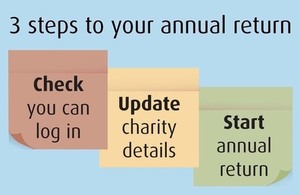
  • filed your Charity Commission Annual Return?
  • had your annual accounts examined?

If you are a charitable company, have you –

  • filed your annual accounts with Companies House?
  • checked when you should complete your Companies House annual return?
  • NO REMINDERS ARE SENT OUT THESE DAYS!
Have you:
  • registered with the Information Commissioner’s Office re Data Protection Fees?
  • checked when your insurance is up for renewal?
  • planned how to continue delivering services under conditions of COVID?
  • established working from home procedures, and will you need to change contracts of employment?
  • thought about how you will recruit new trustees and hold meetings?
  • started preparing your annual budget? If you need any help, do contact DCAS
 …..and finally – don’t forget to feel a sense of pride for all the work your charity does, and the important role charities play in the life of Derby!

Safeguarding and protecting people

Charity Commission LogoProtecting people and safeguarding responsibilities should be a governance priority for all charities. It is a fundamental part of operating as a charity for the public benefit.

As part of fulfilling your trustee duties, whether working online or in person, you must take reasonable steps to protect from harm people who come into contact with your charity.

This includes:

  • people who benefit from your charity’s work
  • staff
  • volunteers
  • other people who come into contact with your charity through its work

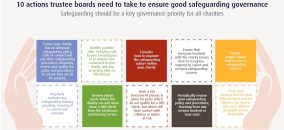
10 actions trustee boards need to take to ensure good safeguarding governance

Click on the picture below

10 Actions Safeguarding

More detailed information and advice can be found here

Charity Fraud Prevention Week – Taking Action

Charity Fraud Awareness Week 2021TAKING ACTION

If you suspect that your charity has fallen victim to insider fraud you should act promptly.

  • Refer to your response plan which should explain how, when and by whom the suspected fraud will be investigated, reported and resolved. It might include engaging external professional support.
  • Report the incident to your relevant national law enforcement agency. In the UK this is Action Fraud (England, Wales and Northern Ireland) or Police Scotland (Scotland only).
  • Report matters promptly to your charity regulator. For reports to the Charity Commission for England and Wales treat it as a serious incident. Use the online form to make your report, stating what happened and how you’re dealing with it.

BUILDING YOUR CHARITY’S DEFENCES

Checklist – Ask yourself:

  • Do we have a workplace culture in which fraud is never acceptable and everyone knows it? (An essential part of preventing fraud is to have the right ‘tone at the top’.)
  • Do we talk openly about fraud and is it clearly explained in our anti-fraud, bribery and corruption policy?
  • Is a whistleblowing policy promoted and supported widely within the organisation?
  • Are we developing standard operating procedures that reduce risk and encourage honesty? Are we making sure they are being followed?
  • Do we perform pre-employment screening of new recruits and in-service checks for established employees? Do we expect our partners to do the same?
  • Are we sharing our knowledge with other organisations so that known fraudsters cannot simply job-hop?
  • Do we offer support to employees in difficulty? (Desperation and dissatisfaction are common causes of fraud.)
  • Do we keep registers of gifts, hospitality and conflicts of interest? Are they transparent and reviewed regularly?
  • Do we provide mandatory anti- fraud and corruption training?
  • Is there a response plan for when an insider fraud does happen?

Charity Fraud Awareness Week 18-22 October 2021 – Insider Fraud

Charity Fraud Awareness Week brings together the charity and not-for-profit sectors from around the world to raise awareness and share good practice in tackling fraud and cybercrime.

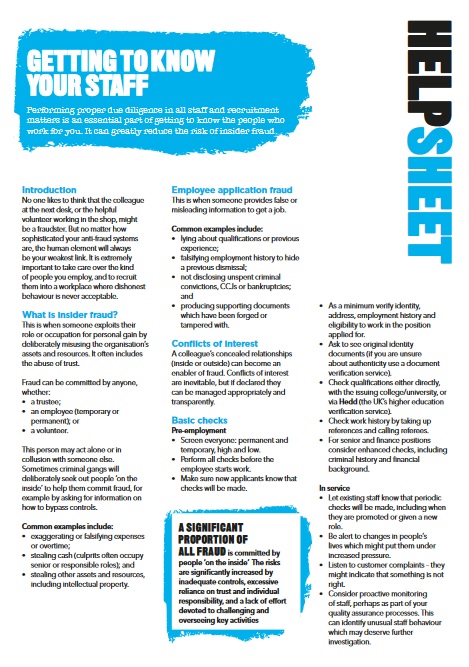
Fraud HelpsheetGetting to know your staff

Performing proper due diligence in all staff and recruitment matters is an essential part of getting to know the people who work for you. It can greatly reduce the risk of insider fraud.
 

What is Insider Fraud?

This is when someone exploits their role or occupation for personal gain by deliberately misusing the organisation’s assets and resources. It often includes the abuse of trust.

Fraud can be committed by anyone, whether:

  • a trustee;
  • an employee (temporary or permanent); or
  • a volunteer.

This person may act alone or in collusion with someone else. Sometimes criminal gangs will deliberately seek out people ‘on the inside’ to help them commit fraud, for example by asking for information on how to bypass controls.

Warning Signs

Certain kinds of individual behaviour can be red flags for insider fraud. For example:

  • an aggressive or bullying manner that makes colleagues unwilling to challenge their behaviour;
  • a tendency to be over-protective of their work or to take on additional tasks beyond their job description;
  • asking to use someone else’s log-in details because they have forgotten their password;
  • an unwillingness to take holidays or be away from the office for more than a day or two at a time;

A very useful helpsheet, kindly prepared by Cifas and the Fraud Advisory Panel, can be downloaded here

Case studies of inside fraud in charities can be found here

Trustee Expenses and Payments

Trustee ExpensesThe concept of unpaid trusteeship has been one of the defining characteristics of the charitable sector, contributing greatly to public confidence in charities. This does not mean that a trustee can never receive any payment or benefit from his or her charity; there are sometimes good reasons why it can be in a charity’s interests to make a payment to a trustee. Trustee boards need, though, to minimise the risks to their charity’s reputation and operation.

Expenses are normally refunds by the charity of costs a trustee has had to meet personally (or which have been met on his or her behalf) in order to carry out trustee duties. In some cases, these expenses may be paid in advance. A refund of properly incurred expenses is not a trustee payment, nor does it count as any kind of personal benefit.

Some types of payment are often confused with expenses, when they are actually trustee benefits which HMRC will consider can be taxed as income. They can only properly be paid out of charity funds if there is suitable authority for doing so.

A charity can pay a trustee for the supply of any services over and above normal trustee duties. The decision to do this must be made by those trustees who will not benefit. They must decide that the service is required by the charity and agree it is in the charity’s best interests to make the payment and must comply with certain other conditions

More detailed information and guidance can be found in this document

Does Your Charity Need an AGM?

AGM imageNot all charities have members or need to have an AGM. The governing document should be checked to see if an AGM is required. A charitable company is only required to hold an AGM where stipulated in its articles of association. If the governing document does not require an AGM, the charity trustees may wish to call one (perhaps calling it a users’ meeting to avoid any confusion with a formal AGM).

Whether the charity is required to have an AGM or simply organise a users’ meeting, the charity trustees are only bound to act on decisions taken by the members where the governing document directs that those matters have to be decided at such a meeting. It is important that charity trustees are clear about the status and purpose of the AGM and that this is clearly communicated to those attending.

Unless the governing document states otherwise, the notice of the AGM will need to be sent to all the members of a charity and to any other people entitled to receive them. Some charities may be required to have an AGM or users’ meeting but not have a membership (for example, a village hall charity). In these cases, the instructions in the governing document about advertising the meeting must be followed. The governing document may state the number of days notice that must be given for calling an AGM. If it does not, reasonable notice should be given.

The commission recommend that copies of the charity’s annual report and accounts are either sent to each member, or made available at the venue prior to the start of the meeting (a company must send copies to all of its members). Anyone can by law request a copy of the accounts from the charity at any time. The charity is entitled to charge a reasonable fee for this.

The governing document may specify the information to be contained in the notice calling an AGM and company law imposes certain requirements in this respect. In all cases the commission recommend, as a minimum, that the notice calling the AGM sets out:

  • the date and time of the meeting
  • the venue
  • the details of the business to be considered (which will probably be mandatory items at this stage as members resolutions may not have been received)
  • an invitation to propose resolutions, and
  • if appropriate, requests for nominations (or the names of proposed nominees) for officers to be elected

More information and guidance can be found here

Watch out for CEO/BEC fraud

 CEOfraudWhat is CHIEF EXECUTIVE OFFICER (CEO) Fraud? 

CEO fraud, also known as Business Email Compromise (BEC), is a type of fraud that is enabled via social engineering. Social engineering is the manipulation of situations and people that results in the targeted individuals divulging confidential information.

CEO fraud involves the impersonation of a senior figure (usually the Chief Executive Officer) with subsequent requests for transfers of funds.

How does CEO fraud happen? 

CEO fraud is a request, often made via email, purporting to come from a senior person in the company, normally to the finance officer, requesting an urgent payment. 

The request may outline that the transaction is confidential and sensitive in order to discourage further verification. The fraudster may pick occasions when the real CEO is out of the office, or on holiday, preventing the financial officer from checking the validity of the request.

How can I help to prevent CEO fraud? A checklist: 

  • Any payment requests with new or amended bank details received by email, letter or phone should be independently verified. This includes internal emails from senior management that contain payment requests. Fraudsters can spoof email addresses to make them appear to be from a genuine contact, including someone from your own organisation.
  • Don’t be pressured by urgent requests, even if they appear to originate from someone senior – remember this is a common tactic adopted by fraudsters.
  • Be cautious of how much information you reveal about your company and key officials via social media platforms and out-of-office automatic replies.
  • Consider removing information such as testimonials from your own or your suppliers’ websites or social media channels that could lead fraudsters to knowing who your suppliers are.
  • Regularly conduct audits on your accounts
  • Make all staff aware of this type of fraud, particularly those that make payments.  
  • Ensure warning messages are understood and that appropriate checks, actions and processes are followed to ensure requests are genuine.
  • Sensitive information you post publicly, or dispose of incorrectly, can be used by fraudsters to perpetrate fraud against you. The more information they have about you, the more convincingly they can purport to be one of your legitimate suppliers or employees. Always shred confidential documents before throwing them away
 What to do if you suspect you’ve fallen victim to impersonation fraud 
  • If you believe you’ve fallen victim to a CEO fraud attack, contact your bank immediately. They will try to recover the money from the fraudster’s bank account. The quicker you alert your bank, the greater the chance of recovering the funds. 
  • Report it to ActionFraud – the police’s national fraud and cyber crime reporting centre. Even if you’ve not suffered any financial loss, this will allow the police to analyse trends and help them to prevent fraudsters exploiting other companies. You can file a report via their website at www.actionfraud.police.uk
  • Charities affected by fraud should also report it to the Charity Commission as a serious incident.
  • Where appropriate, the Charity Commission can also provide timely advice and guidance.

How To Convert a Community Interest Company to a CIO

Charity Commission LogoIf you are a Community Interest Company (CIC) you can apply to the Charity Commission to convert directly to a Charitable Incorporated Organisation (CIO).

Step 1: Prepare a conversion resolution

The directors of the CIC will need to produce a conversion resolution which confirms that the members of the CIC wish to convert the CIC into a CIO under the Charitable Incorporated Organisations (Conversion) Regulations which came into force on 1 September 2018.

Step 2: Adopt Charity Commission model CIO constitution

Adopt and complete one of the model CIO constitutions found here

Replace ‘CIC’ with ‘CIO’ in the name to reflect that the organisation has converted.

Section 8 of the model CIO constitution covers if members would be liable to contribute to the assets of the CIO if it is wound up.

If the amount each member would be liable for is more than £10, you must select option 2 to confirm:

  • the CIO’s members will be liable to contribute to its assets if it is wound up
  • the amount up to which they will be liable for

The amount you enter in section 2(i) must not be less than the amount up to which the CIC’s members were liable to contribute to the assets of the CIC if it were wound up.

If the amount each member of the CIC is liable to contribute to its assets if it winds up is £10 or less, you can select option 1.

Step 3: Prepare a resolution adopting the CIO constitution

Prepare a resolution adopting the proposed constitution of the CIO. The resolution must confirm that the members of the CIC have adopted the proposed constitution of the CIO.

Step 4: Apply for charitable status

To apply for charitable status as a CIO, you will need to apply to register as a charity and also submit:

  • the resolution of conversion of the CIC to a CIO
  • the proposed constitution of the CIO
  • the resolution of the CIC adopting the proposed constitution of the CIO
  • a completed Trustee Declaration Form

In the ‘Special Circumstances’ section of your application, write that you are a CIC wishing to apply for charitable status as a CIO. Tell us the name of the CIC.

More help can be found here

After you have applied

The Charity Commission will check that you can register as a charity.

If you can they will give Companies House what they need to confirm to the Regulator of Community Interest Companies that you wish to convert your CIC to a CIO.

Once approved, Companies House will cancel the registration of the CIC and the Charity Commission will then register the CIO as a charity and let the trustees know.

From The Charity Commission: How We Identify Risks

Charity Commission LogoTo achieve our purpose and fulfil our statutory functions, we are risk-led in our regulation, which means:

  • being proactive in identifying risks and intervening, where possible, to prevent harm before it occurs
  • addressing harm effectively where it occurs
  • focusing our resources effectively on the highest risks

How we identify risks

We identify risks from a wide range of sources including, but not limited to:

  • information charities include in their annual return and accounts
  • serious incident reports from trustees
  • reporting by auditors and independent examiners
  • reports of serious wrongdoing in charities from employees and volunteers, including whistleblowing
  • complaints from the public or public sources
  • our engagement with charities
  • our work with other bodies, departments and agencies
  • concerns raised in the media and by members of parliament

We place an emphasis on being proactive and identifying risks as soon as possible. To achieve this we:

  • identify trends to get a better understanding of the evolving threats and risks to the ability of charity to thrive and inspire trust and confidence
  • analyse the data, information and knowledge that we gather from the sources mentioned above
  • use our awareness of changes to the environment in which charities are operating and the main challenges facing the charity sector

How we respond to risks

Our approach is underlined by our general functions as set out above, which include:

  • determining whether institutions are charities
  • encouraging and facilitating the better administration of charities
  • identifying and investigating apparent misconduct or mismanagement in the administration of charities and taking corresponding remedial or protective action

We will prioritise our casework resources towards addressing the highest risks, those which have the potential to cause the highest level of harm to public trust and confidence, or which may affect trustees’ ability to comply with their duties.

The level and nature of some risks will be such that it would not be proportionate to use our resources to undertake direct regulatory action or engagement with the charity. However, this does not mean that we do not want to be notified of these risks. Whilst we may not take regulatory action, we may still contact a charity’s trustees to alert them to the concerns raised with us. We may keep such information in our records and reassess our response if further information comes to light. We will also use the information to inform our wider understanding of risks. This may result in actions that deal with risk in a thematic way, for example publishing a report of our overall findings or issuing a regulatory alert to all or a relevant category of charities.

There will be some limited cases where the level and nature of risk identified means that another regulator or agency is better placed to respond, for example serious criminal matters. In such cases, we will work with the other regulator or agency to ensure the appropriate response.

An increased level of Commission involvement with a charity or on an issue does not necessarily mean that something has already gone wrong. It may simply mean that a risk requires a greater regulatory involvement or scrutiny.

Since the nature and level of a risk may change during the course of a particular case, we may need to periodically review our response.

You can read more here