Tag: Companies House

Voluntary dissolution of a CIC

A Community Interest Company, CIC, is a special type of limited company which exists to benefit the community rather than private shareholders.

Under section 53 of the Companies (Audit, Investigations and Community Enterprise) Act 2004 a CIC is only allowed to cease being a CIC by dissolution, or by converting to a charity. This means that once a company has become a CIC it can’t convert to an ordinary limited company.

There are a number of different routes to dissolution, each with its own rules and procedures.

Dissolution is fully explained in the Companies House booklet ‘Strike-off, Dissolution and Restoration’.

Apply to voluntarily dissolve a CIC

Complete and send Form DS01 to the Registrar of Companies, with a cheque for £10 made payable to Companies House.

When the form is accepted, a notice will be placed in the London Gazette – or the Edinburgh and Belfast editions as appropriate – giving at least 2 months notice of the intent to remove the company.

If you wish to transfer assets for less than full consideration to an asset locked body that is not already specified in the articles of association, you will need the consent of the Regulator and must complete form CIC53. The information supplied will be used to help the Regulator decide whether or not to object to the striking off of the CIC.

Please note:

  • a ‘transfer’ includes every description of disposition, payment, release or distribution, and the creation or extinction of an estate or interest in, or right over, any property.

More detailed information and help can be found here

How To Convert a Community Interest Company to a CIO

Charity Commission LogoIf you are a Community Interest Company (CIC) you can apply to the Charity Commission to convert directly to a Charitable Incorporated Organisation (CIO).

Step 1: Prepare a conversion resolution

The directors of the CIC will need to produce a conversion resolution which confirms that the members of the CIC wish to convert the CIC into a CIO under the Charitable Incorporated Organisations (Conversion) Regulations which came into force on 1 September 2018.

Step 2: Adopt Charity Commission model CIO constitution

Adopt and complete one of the model CIO constitutions found here

Replace ‘CIC’ with ‘CIO’ in the name to reflect that the organisation has converted.

Section 8 of the model CIO constitution covers if members would be liable to contribute to the assets of the CIO if it is wound up.

If the amount each member would be liable for is more than £10, you must select option 2 to confirm:

  • the CIO’s members will be liable to contribute to its assets if it is wound up
  • the amount up to which they will be liable for

The amount you enter in section 2(i) must not be less than the amount up to which the CIC’s members were liable to contribute to the assets of the CIC if it were wound up.

If the amount each member of the CIC is liable to contribute to its assets if it winds up is £10 or less, you can select option 1.

Step 3: Prepare a resolution adopting the CIO constitution

Prepare a resolution adopting the proposed constitution of the CIO. The resolution must confirm that the members of the CIC have adopted the proposed constitution of the CIO.

Step 4: Apply for charitable status

To apply for charitable status as a CIO, you will need to apply to register as a charity and also submit:

  • the resolution of conversion of the CIC to a CIO
  • the proposed constitution of the CIO
  • the resolution of the CIC adopting the proposed constitution of the CIO
  • a completed Trustee Declaration Form

In the ‘Special Circumstances’ section of your application, write that you are a CIC wishing to apply for charitable status as a CIO. Tell us the name of the CIC.

More help can be found here

After you have applied

The Charity Commission will check that you can register as a charity.

If you can they will give Companies House what they need to confirm to the Regulator of Community Interest Companies that you wish to convert your CIC to a CIO.

Once approved, Companies House will cancel the registration of the CIC and the Charity Commission will then register the CIO as a charity and let the trustees know.

Converting A Charitable Company To A Charitable Incorporated Organisation (CIO)

We're now a Charitable Incorporated Organisation (CIO) - Raising Futures  KenyaThe main advantage of CIOs over charitable companies is that CIOs don’t have to register with and send accounts to Companies House as well as the Charity Commission.
Changing to a different charitable structure usually involves setting up a new charity, transferring your original charity’s assets and liabilities to it then closing your original charity.

The conversion process should be simple and straightforward in most cases. As part of this process, the new CIO Constitution and Special Resolution will need to be included before submission to the Commission.

Using this process means that the charity continues to exist but in a different form. This means you’ll be able to keep the charity’s existing name and charity number.

You should also be able to keep the charity’s existing bank accounts and in most cases the new CIO should receive any legacies left to the original charitable company.

To change a company into a CIO you need to apply to the Charity Commission here.

The Commission will liaise with Companies House to ensure that necessary records are updated correctly. This will mean that the date of conversion of the charitable company to a CIO – as shown on the public register of charities – will match the date of removal of the charitable company at Companies House.

Please note that due to limited resources, your application may be rejected if:

  • complete documentation is not sent or received
  • your charity is not in compliance with its reporting requirements to the Charity Commission and Companies House
  • your charity has made any changes to the new CIO governing document that would require the Charity Commission’s approval including:
    • name change, except a minor change such as removing limited or company and replacing it with CIO and also if the name is not one that is regulated on the business register and no approval has been submitted with the application
    • any additional trustee benefits especially if there is an express prohibition in the company’s governing document
    • amendments to the dissolution clause that will change the spirit of the intention of who receives the funds on dissolution

More information about changing your charity’s structure can be found here

Companies House Stops Postal Reminders for Annual Returns

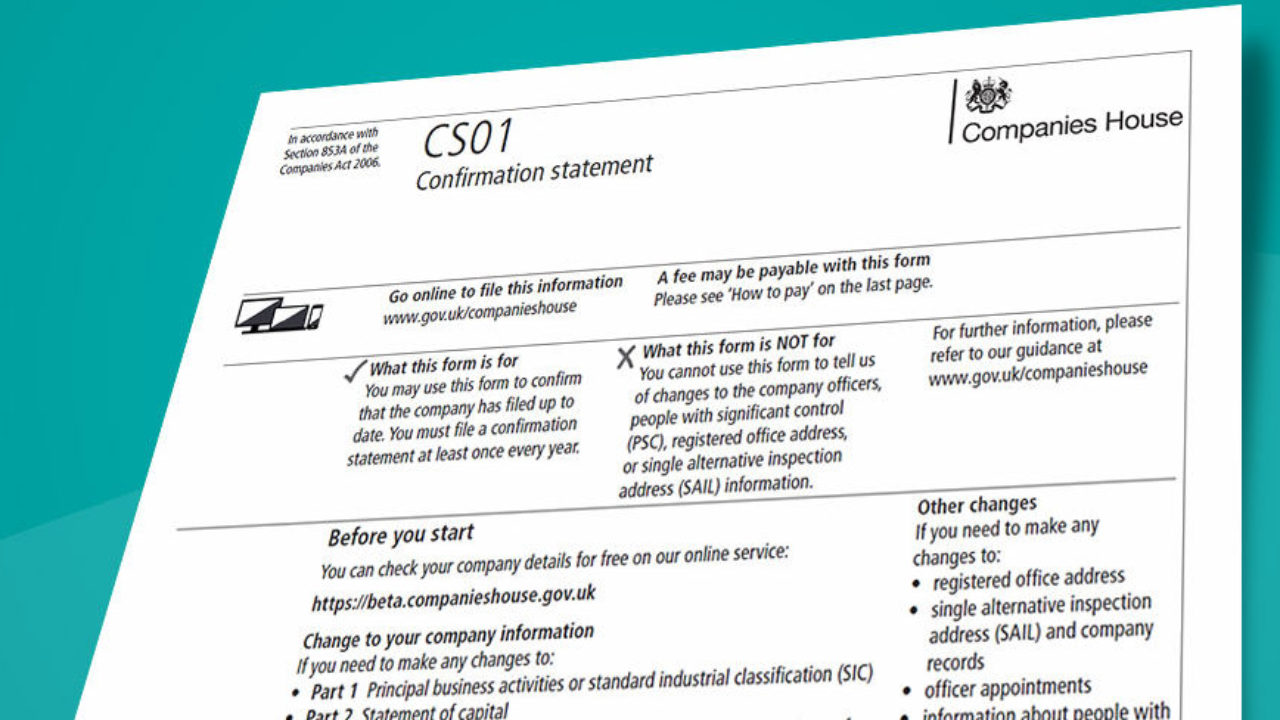
The confirmation statement explainedCompanies House will no longer send out postal reminders for filing your Annual Return, now known as the Confirmation Statement, as part of their aim to become a fully-digital organisation and all companies should now register for the email reminder service

They say that Companies who have already switched to email reminders from paper are more likely to file their accounts and confirmation statement (annual return) on time, and are less likely to get a penalty for filing their accounts late.

Their email reminder service is free and has many advantages over the paper system. You can:

  • choose up to 4 people to receive a reminder (including an agent)
  • file your document immediately from a link within the reminder
  • receive reminders more conveniently
  • use less paper, contributing to saving the environment

How to register

  1. sign in to the Companies House online filing service
  2. select ‘Get email reminders’ from your company overview screen
  3. click ‘Add an email address’
  4. enter your email address (a maximum of 4 per company)
  5. click the link in the email Companies House sends you to validate your email address
  6. agree to the terms of operation

They will send you an email when you have successfully joined the reminder service.

New users will need to register to use the Companies House online filing service.

You can file your Confirmation Statement here

Closing Down A Charitable Company

Related imageThe company must first of all be removed from the Companies Register but only if it:
  • hasn’t traded or sold off any stock in the last 3 months
  • hasn’t changed names in the last 3 months
  • isn’t threatened with liquidation
  • has no agreements with creditors, eg a Company Voluntary Arrangement (CVA)

A company can apply to the registrar to be struck off the register and dissolved if it’s no longer needed, for example if:

  • the directors wish to retire and there is no one to take over the running of the company
  • the company is a subsidiary whose name is no longer needed
  • the company was originally set up to exploit an idea that turned out not to be feasible

More details can be found here:

Once the company has been removed from the Companies House Register, it can be removed from the Register of Charities.

A charitable company has an automatic right to expend all of its assets on its purposes.

You can tell the Charity Commission that you have wound it up by completing the closure form. This can be done online – more details  can be found here:

Company Tax Returns

Image result for charity company tax returnCompany Tax Returns

You must complete a Company Tax Return if your charity is a limited company or unincorporated association when this is required by HM Revenue and Customs. You need to include the supplementary pages for charities and community amateur sports clubs (CASCs).

A charity is a limited company if it was set up by a:

  • constitution
  • memorandum and articles of association
  • royal charter or Act of Parliament

Limited companies must also send annual accounts to Companies House. You must complete a tax return when HMRC asks you to, even if no tax is due. You may have to pay a penalty if your tax return is late or you don’t complete one when you should.

You can find more information about charities and tax here

Changing Your Charity’s Governing Document

You can apply to change your charity’s governing document. 

Before you start

You must:

You’ll need:

  • details of the changes you want to make
  • reasons for the changes
  • the date the changes were accepted by Companies House, if your charity is a company and you already have consent from the Charity Commission

You may be asked to upload your governing document as a PDF as part of the online application.

More detailed information can be found here

Changing Your Charity’s Structure

When to change charity structure

Changing to a different charitable structure usually involves setting up a new charity, transferring your original charity’s assets and liabilities to it then closing your original charity.

Your charity’s legal structure sets out what type your charity is. There are four common types of charity structure:

  • charitable incorporated organisation (CIO) – there are 2 structures; association CIO and foundation CIO
  • charitable company (limited by guarantee)
  • unincorporated association
  • trust

Your charity’s legal structure determines:

  • who will run it and whether it will have a wider membership
  • whether it can enter into contracts or employ staff in its own name
  • whether its trustees are personally liable for what it does

A “Changing Charity Structure Checklist” can be found here

Informing Companies House of Changes

You must tell Companies House about any changes to your limited company, including:

  • directors and company secretaries, eg new appointments, resignations or changes to their personal details
  • changing your company name
  • changing your registered office address
  • changing your accounting reference date
  • changing where your company records are kept, if different from your registered address
  • which records you’ll keep at an alternative address

More information can be found here