Tag: minimum wage

National Minimum Wage and National Living Wage rates

The government reviews minimum wage rates every year and they’re usually updated in April.  Check when rate increases must be paid.

From 1 April 2024, workers aged 21 and over will be entitled to the National Living Wage.

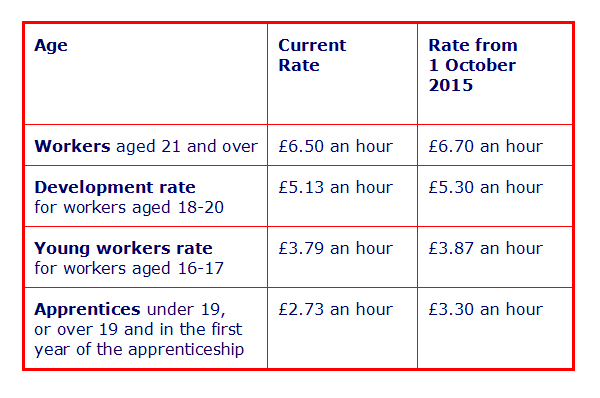
21 and over18 to 20Under 18Apprentice
April 2024£11.44£8.60 £6.40 £6.40 

It’s against the law for an employer to pay less than the National Minimum Wage or National Living Wage.
They also must keep accurate pay records and make them available when requested.
If an employer has not been paying the correct minimum wage, they should resolve the problem as soon as possible.
The employer must also resolve any backdated non-payment of minimum wage. This is even if the employee or worker no longer works for them.

It’s against the law for an employer to pay less than the National Minimum Wage or National Living Wage.
They also must keep accurate pay records and make them available when requested.
If an employer has not been paying the correct minimum wage, they should resolve the problem as soon as possible. The employer must also resolve any backdated non-payment of minimum wage. This is even if the employee or worker no longer works for them.

It’s against the law for an employer to pay less than the National Minimum Wage or National Living Wage.
They also must keep accurate pay records and make them available when requested.
If an employer has not been paying the correct minimum wage, they should resolve the problem as soon as possible.
The employer must also resolve any backdated non-payment of minimum wage. This is even if the employee or worker no longer works for them.

ACAS has more information here

Who is entitled to Minimum Wage?

People classed as ‘workers’ must be at least school leaving age to get the National Minimum Wage. They must be 23 or over to get the National Living Wage.

Contracts for payments below the minimum wage are not legally binding. The worker is still entitled to the National Minimum Wage or National Living Wage.

Workers are also entitled to the correct minimum wage if they’re:

  • part-time
  • casual labourers, for example someone hired for one day
  • agency workers
  • workers and homeworkers paid by the number of items they make
  • apprentices
  • trainees, workers on probation
  • disabled workers
  • agricultural workers
  • foreign workers
  • seafarers
  • offshore workers

Apprentices

Apprentices are entitled to the apprentice rate if they’re either:

  • under 19
  • 19 or over and in the first year of their apprenticeship

Apprentices over 19 who have completed the first year of their apprenticeship are entitled to the correct minimum wage for their age.

Not entitled to the minimum wage

The following types of workers are not entitled to the National Minimum Wage or National Living Wage:

  • self-employed people running their own business
  • company directors
  • people who are volunteers or voluntary workers
  • workers on a government employment programme, such as the Work Programme
  • members of the armed forces
  • family members of the employer living in the employer’s home
  • non-family members living in the employer’s home who share in the work and leisure activities, are treated as one of the family and are not charged for meals or accommodation, for example au pairs
  • workers younger than school leaving age (usually 16)
  • higher and further education students on work experience or a work placement up to one year
  • people shadowing others at work
  • workers on government pre-apprenticeships schemes
  • people on the following European Union (EU) programmes: Leonardo da Vinci, Erasmus+, Comenius
  • people working on a Jobcentre Plus Work trial for up to 6 weeks
  • share fishermen
  • prisoners
  • people living and working in a religious community

Employers who offer internships (sometimes called ‘work placements’ or ‘work experience’) should check if the person is entitled to the minimum wage.

Voluntary work

You’re classed as doing voluntary work if you can only get certain limited benefits (for example reasonable travel or lunch expenses) and you’re working for a:

  • charity
  • voluntary organisation or associated fundraising body
  • statutory body

Contact the Acas helpline to find out if you should be getting the minimum wage.

National Minimum Wage and National Living Wage rates

Current rates

These rates are for the National Living Wage (for those aged 23 and over) and the National Minimum Wage (for those of at least school leaving age). The rates change on 1 April every year.

23 and over21 to 2218 to 20Under 18Apprentice
April 2022 (current rate)£9.50£9.18£6.83£4.81£4.81
April 2023£10.42£10.18£7.49£5.28£5.28

Apprentices

Apprentices are entitled to the apprentice rate if they’re either:

  • aged under 19
  • aged 19 or over and in the first year of their apprenticeship

More information and examples can be found here