Tag: Sick Pay

Changes To The Fit Note

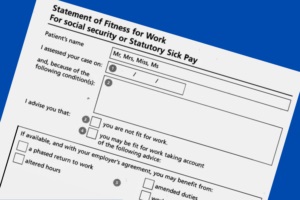
You may notice changes to the fit note you receive from a healthcare professional as a new version of the fit note that was introduced in April 2022. The requirement for the healthcare professional to sign the form in ink has been removed and replaced by the issuer’s name and profession.

There will be a period during which both the new and previous version of the fit notes are legally valid whilst relevant IT systems are updated and stocks of paper fit notes are replaced.

5 things to do if you are given a fit note by an employee

  1. Check whether your employee’s healthcare professional has assessed that they are not fit for work or may be fit for work.
  2. Check how long your employee’s fit note applies for, and whether they are expected to be fit for work when their fit note expires.
  3. If your employee may be fit for work, discuss their fit note with them and see if you can agree any changes to help them come back to work while it lasts.
  4. If your employee is not fit for work, or if they may be fit for work but you can’t agree any changes, use the fit note as evidence for your sick pay procedures.
  5. Consider taking a copy of the fit note for your records (your employee should keep the original).

Key things to keep in mind

  • Supporting someone with a health condition to come back to work can save you money and minimise disruption
  • People can often come back to work before they are 100% fit – in fact work can even help their recovery.
  • Often, a few simple changes can help someone with a health condition come back to work earlier.
  • Access to Work can help employees with a disability or health condition. This includes paying towards equipment or support.
  • If your employee is assessed as may be fit for work, their fit note will help you discuss with them what these changes might be.
  • The fit note won’t tell you what changes to make, but will give you advice about how your employee’s health affects what they can do at work.
  • If you can’t make any changes to take account of the advice in the fit note, you don’t have to.
  • The fit note tells you whether your employee is expected to be fit for work at the end of their fit note.
  • If your employee’s healthcare professional thinks they are fit for work, they will not be issued with a fit note.
  • Your employee can come back to work at any time, even if this is before their fit note expires. They do not need to go back to their healthcare professional first.
  • The fit note belongs to your employee and they should keep the original. You may decide to take a copy for your records.
Sick Pay and Holiday Pay

Sick Pay and Holidays jpegACAS answers questions about sick pay and holiday pay

Employees cannot get sick pay and holiday pay at the same time.

Taking holiday while off sick

An employee can take holiday (annual leave) while off sick. For example, if they: 

  • are not physically able to work, but physically able to take a holiday
  • have a mental health condition that might be helped by a holiday
  • are off sick long term and a holiday might help with their recovery

It’s up to an employee to request holiday while off sick. An employer cannot force an employee to take holiday while off sick.

If the employer approves the employee’s holiday request:

  • sick leave can be paused while the employee takes holiday
  • the employee should get holiday pay while they are on holiday

After the employee has taken the holiday, sick leave can continue if they’re still not well enough to return to work.

If an employee is sick on holiday 

An employee must report their sickness to their employer if they want to take any holiday as sick leave.

In this case the employee can:

  • get sick pay for the time they were sick (as long as they areentitled to sick pay)
  • keep the time they were sick to use as holiday another time

More information from ACAS can be found here

More information from the government can be found here

Coronavirus and Sick Pay

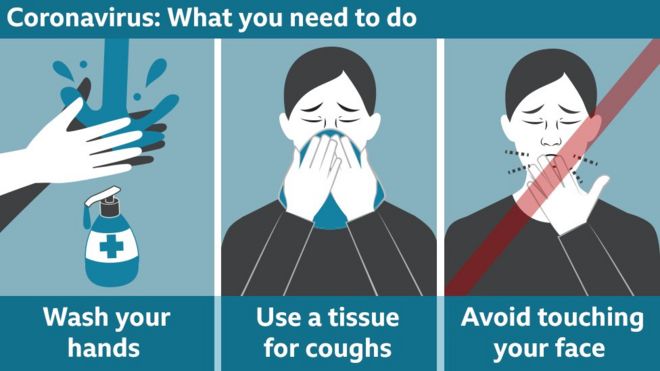
Coronavirus graphic on what you need to doWe have been asked for clarification on Sick Pay during the Coronavirus, so here is the official Government advice

Sick pay

Those who follow advice to stay at home and who cannot work as a result will be eligible for statutory sick pay (SSP), even if they are not themselves sick.

Employers should use their discretion and respect the medical need to self-isolate in making decisions about sick pay.

Anyone not eligible to receive sick pay, including those earning less than an average of £118 per week, some of those working in the gig economy, or self-employed people, is able to claim Universal Credit and or contributory Employment and Support Allowance.

For those on a low income and already claiming Universal Credit, it is designed to automatically adjust depending on people’s earnings or other income. However, if someone needs money urgently they can apply for an advance through the journal.

Certifying absence from work

By law, medical evidence is not required for the first 7 days of sickness. After 7 days, employers may use their discretion around the need for medical evidence if an employee is staying at home.

We strongly suggest that employers use their discretion around the need for medical evidence for a period of absence where an employee is advised to stay at home either as they are unwell themselves, or live with someone who is, in accordance with the public health advice issued by the government.

More details are available by clicking here

Advice for Employers is available from ACAS

Working from home

For any employee working from home, the employer should:

  • pay the employee as usual
  • keep in regular contact
  • check on the employee’s health and wellbeing

Find out more about:

If evidence is required to cover self-isolation or household isolation beyond the first 7 days of absence then employees can get an isolation note from NHS 111 online or from the NHS website.

More advice from ACAS can be found by clicking here

Coronavirus (COVID-19) Guidance for Employers, and Social Distancing Advice

Image result for coronavirusIn these very uncertain times, we thought it prudent to direct you to a few documents which are very clear, detailed and helpful for both Employers and Employees regarding Coronavirus (COVID -19)
Guidance from ACAS on the Coronavirus can be found here – this gives very clear advice for both employers and employees, and answers some difficult questions regarding sick pay, working from home and social distancing

Guidance for Employers –  this guidance from the government is updated daily, and can be found here 

Guidance on Social Distancing – can be found  here – this gives more detail of the groups who are at increased risk of severe illness from Coronavirus, and explains Social Distancing in more detail

Sick Leave and Holidays

Sick leave and holiday

Statutory holiday sicknessentitlement is built up (accrued) while an employee is off work sick (no matter how long they’re off).
Any statutory holiday entitlement that isn’t used because of illness can be carried over into the next leave year. If an employee is ill just before or during their holiday, they can take it as sick leave instead.

An employee can ask to take their paid holiday for the time they’re off work sick. They might do this if they don’t qualify for sick pay, for example. Any rules relating to sick leave will still apply.

Employers can’t force employees to take annual leave when they’re eligible for sick leave.

Paymoney-in-deckchair-123rf-115920262

When an employee changes their holiday to sick leave they’re paid Statutory Sick Pay which will count towards the amount of holiday pay they’ve received. The exceptions to this rule are:

  • they don’t qualify for Statutory Sick Pay
  • they were off work sick and being paid ‘occupational sick pay’

When to Start Paying Sick Pay

https://i0.wp.com/news.lanop.co.uk/wp-content/uploads/2012/09/sick-duck-83431_184x184.jpgWhen to start paying SSP

SSP is paid when the employee is sick for at least 4 days in a row (including non-working days). You start paying SSP from the fourth ‘qualifying day’ (day an employee is normally required to work). The first 3 qualifying days are called ‘waiting days’.

You can’t count a day as a sick day if an employee has worked for a minute or more before they go home sick.

If an employee works a shift that ends the day after it started and becomes sick during the shift or after it has finished, the second day will count as a sick day.

Exception

You don’t usually pay SSP for the first 3 qualifying days unless they’ve been off sick and getting SSP within the last 8 weeks.

More detailed information can be found here