Tag: The Essential Trustee
 DCAS has always been proud of its record in providing volunteering opportunities and this has in many occasions helped further the careers of our volunteers.
 This has never been more true than the case of Baker Salah, who after helping write our accounting manual ‘The Adventures of Mr Claw in the World of Charity Accounting’ has gone on to become a University Lecturer and will soon be awarded his Doctorate in Accounting and Finance. Well done Baker!!!
Volunteers are the bedrock of the voluntary sector. Without them we would not exist, as it is volunteers when acting as trustees who run charities.
Charity trustees
Charity trustees direct how a charity is run and help make sure it does what it was set up to do. This includes making sure the charity:
- sticks to its charitable mission
- has the money it needs
- spends that money responsibly on the activities it was raised for
- follows the law and doesn’t break its own rules
Charity trustees are also known as:
- directors
- board members
- governors
- committee members
Find out more here
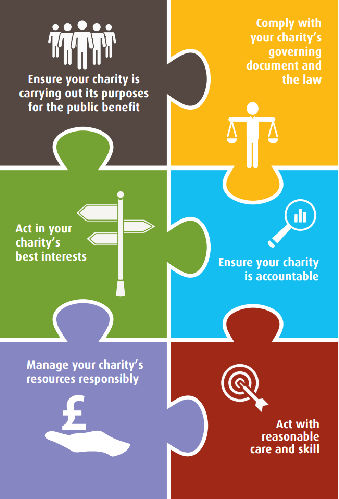
 Trustees have overall control of a charity and are responsible for making sure it’s doing what it was set up to do. Their main duties are:
1. Ensure your charity is carrying out its purposes for the public benefit
You and your co-trustees must make sure that the charity is carrying out the purposes for which it is set up, and no other purpose.
2. Comply with your charity’s governing document and the law
You and your co-trustees must:
- make sure that the charity complies with its governing document
- comply with charity law requirements and other laws that apply to your charity
3. Act in your charity’s best interests
You must:
- do what you and your co-trustees (and no one else) decide will best enable the charity to carry out its purposes
- with your co-trustees, make balanced and adequately informed decisions, thinking about the long term as well as the short term
- avoid putting yourself in a position where your duty to your charity conflicts with your personal interests or loyalty to any other person or body
- not receive any benefit from the charity unless it’s properly authorised and is clearly in the charity’s interests; this also includes anyone who is financially connected to you, such as a partner, dependent child or business partner
4. Manage your charity’s resources responsibly
You must act responsibly, reasonably and honestly. This is sometimes called the duty of prudence. Prudence is about exercising sound judgement.
5. Act with reasonable care and skill
As someone responsible for governing a charity, you:
- must use reasonable care and skill, making use of your skills and experience and taking appropriate advice when necessary
- should give enough time, thought and energy to your role, for example by preparing for, attending and actively participating in all trustees’ meetings
6. Ensure your charity is accountable
You and your co-trustees must comply with statutory accounting and reporting requirements.
Find out more here
 You and your co-trustees must make sure that everything your charity does helps (or is intended to help) to achieve the purposes for which it is set up, and no other purpose. This means you should:
- ensure you understand the charity’s purposes as set out in its governing document
- plan what your charity will do, and what you want it to achieve
- be able to explain how all of the charity’s activities are intended to further or support its purposes
- understand how the charity benefits the public by carrying out its purposes
Spending charity funds on the wrong purposes is a very serious matter; in some cases trustees may have to reimburse the charity personally.
More details can be found here
 DCAS has always been proud of its record in providing volunteering opportunities and this has in many occasions helped further the careers of our volunteers.
 This has never been more true than the case of Baker Salah, who after helping write our accounting manual ‘The Adventures of Mr Claw in the World of Charity Accounting’ has gone on to become a University Lecturer and will soon be awarded his Doctorate in Accounting and Finance. Well done Baker!!!
 Derby Community Accountancy Service