-
Understanding Your Tax Code
 Your tax code will normally start with a number and end with a letter
1150L is the tax code currently used for most people who have one job or pension
The numbers in your tax code tell your employer or pension provider how much tax-free income you get in that tax year
- HMRC works out your tax-free Personal Allowance
- Income that you haven’t paid tax on (such as untaxed interest or part-time earnings) and the value of any benefits from your job (such as a company car) are added up
- The income that you haven’t paid tax on is taken away from your Personal Allowance. What’s left is the tax-free income you’re allowed in a tax year
- The last digit in the tax-free income amount is removed
Letter
What it means
L
You’re entitled to the standard tax-free Personal Allowance
M
Marriage Allowance: you’ve received a transfer of 10% of your partner’s Personal Allowance
N
Marriage Allowance: you’ve transferred 10% of your Personal Allowance to your partner
S
Your income or pension is taxed using the rates in Scotland.
T
Your tax code includes other calculations to work out your Personal Allowance, for example it’s been reduced because your estimated annual income is more than £100,000
0T
Your Personal Allowance has been used up, or you’ve started a new job and your employer doesn’t have the details they need to give you a tax code
BR
All your income from this job or pension is taxed at the basic rate (usually used if you’ve got more than one job or pension)
D0
All your income from this job or pension is taxed at the higher rate (usually used if you’ve got more than one job or pension)
D1
All your income from this job or pension is taxed at the additional rate (usually used if you’ve got more than one job or pension)
NT
You’re not paying any tax on this income
You can check your tax code here
-
Paternity Leave and Pay
 Paternity Leave
You must tell your employer at least 15 weeks before the week the baby is expected:
- the baby’s due date
- when you want your leave to start, for example the day of the birth or the week after the birth
- if you want 1 or 2 weeks’ leave
Work out when to tell your employer you want Paternity Leave online.
Your employer can ask for this in writing. You can ask for Paternity Pay at the same time, if you use form SC3 (or your employer’s own version).
-
Business Planning Day
 Thanks to all those who attended our Business Planning Day yesterday.
If you fail to plan, you plan to fail
Business Planning is essential to the welfare of all organisations. Our instruction manual has a whole section devoted to this essential subject.
-
Informing HMRC about a new employee
 You must tell HM Revenue and Customs (HMRC) when you take on a new employee and be registered as an employer.
Before you pay your new starter follow these steps:
- Check you need to pay them through PAYE.
- Get employee information to work out their tax code – if you don’t have their P45, use HMRC’s ‘starter checklist’ (which replaced the P46).
- Find out if they need to repay a student loan.
- Use these details to set up your new employee in your payroll software.
- Register your employee with HMRC using a Full Payment Submission (FPS).
-
News from the Charity Commission
Do small charity annual reports and accounts meet the reader’s needs?
 We are reviewing small charities’ annual reports and accounts because they are the prime means by which the trustees are publicly accountable to donors, beneficiaries and the wider public for the charity’s activities and how they have used the charity’s money. Good reporting is important to public trust and confidence in both the reporting charity and the wider charity sector.
We were led us to focus on the following criteria:
- have the trustees provided us with both an annual report and accounts?
- does the annual report explain what activities the charity had carried out during the year to achieve its purposes?
- do the accounts contain both an analysis of receipts and payments and a statement of assets and liabilities and are these consistent with each other?
-
Your Rights If Your Employer Is Insolvent

If your employer is ‘insolvent’ this means it can’t pay its debts. You have rights if this happens and can make a claim for money you’re owed.
What you can claim
The money will be paid to you by the government. It’s not guaranteed that you’ll get everything your employer owes you but you can claim for:
- statutory notice pay
- redundancy
- up to 8 weeks’ wages, including a payment for a protective award if your employer has failed to consult collectively with staff
- up to 6 weeks’ holiday pay
- unpaid pension contributions – get in touch with the insolvency practitioner to claim this for you
- a basic award for unfair dismissal
You can get up to £479 a week for each claim. For example, if you’ve claimed for redundancy and loss of notice you can get payments for both.
-
Charity Commission “15 Questions” Checklist
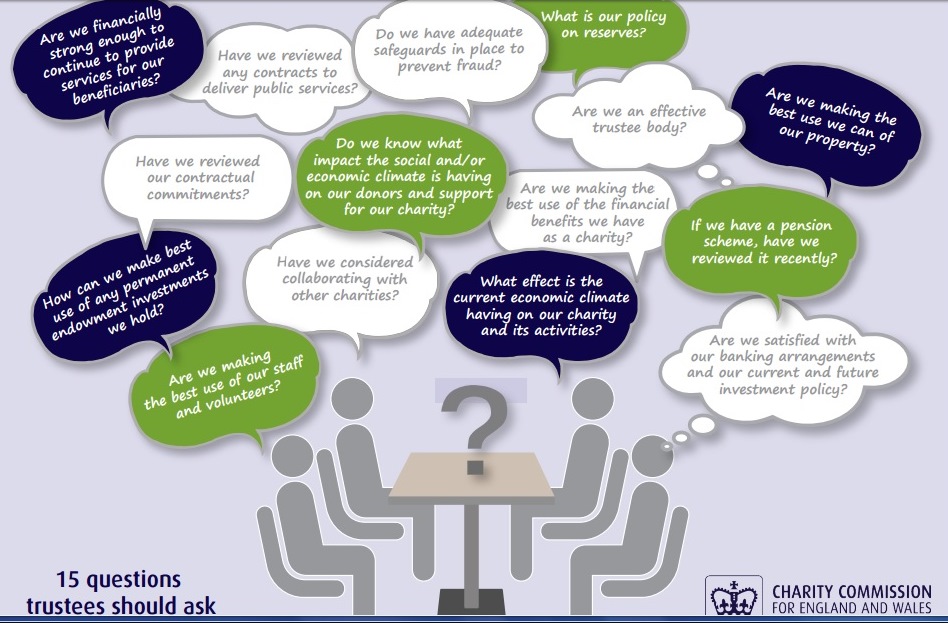 The Charity Commission has updated its 15 questions checklist which is a great tool to check you’ve got the basics covered, identify priorities for the coming year, and review your charity’s overall financial effectiveness.
 -
Starting the New Financial Year on the Right Foot
 Robust financial management is vital so charities can protect themselves against financial difficulties or abuse, and meet the needs of their beneficiaries.
There’s no better time than the start of the new financial year to assess your charity’s financial situation and financial controls, to see how you can improve them. Doing this is key to making sure that your trustees are able to protect the charity’s assets and resources.
The Charity Commission has recently updated their Charity finances: trustee essentials (CC25) guidance to help trustees and charity staff get to grips with the basic areas of financial management. It also links to more detailed guidance on a number of areas.
-
Charity Reserves
 What Are Reserves?
Reserves are that part of a charity’s unrestricted funds that is freely available to spend on any of the charity’s purposes. This definition excludes restricted income funds and endowment funds, although holding such funds may influence a charity’s reserves policy. Reserves will also normally exclude tangible fixed assets such as land, buildings and other assets held for the charity’s use. It also excludes amounts designated for essential future spending.
Reserves also exclude funds which have particular restrictions on how they can be used. Trustees should consider for what purpose restricted funds are held and how they are being used in order to identify those resources that are freely available to spend.
-
Newsletter Spring 2017

Our Spring Newsletter has arrived, and should be with you very soon. If you have not received your copy by 27th April 2017, please let us know here, and we will send one out to you as soon as possible.
-
Subscribe
Subscribed
Already have a WordPress.com account? Log in now.
 Derby Community Accountancy Service