-
Deadlines For Filing Charitable Company Accounts
A Reminder from Companies House
 If your charity is registered as a company with Companies House, and your year end is 31st March, your MUST file your company accounts with Companies House by 31st December
For other year end dates, the deadline is:
- 9 months from the accounting reference date for a private company
- 6 months from the accounting reference date for a public company
Please be aware of the definition of a period of months in connection with filing accounts. A period of months after a given date ends on the corresponding date in the appropriate month. For example a private company with an accounting reference date of 4 April has until midnight on 4 January of the following year to deliver its accounts, not 31 January. This does not apply if your accounting reference date is the last day of the month. In this case the period allowed for filing accounts would end with the last day of the appropriate month. For example a private company with an accounting reference date of 30 April has until midnight on 31 January of the following year to deliver its accounts, not 30 January.
If a filing deadline falls on a Sunday or Bank Holiday, the law still requires you to file the accounts by that date. To avoid a penalty, please ensure that you send acceptable accounts in time to arrive before the deadline.
It’s the date that you deliver acceptable accounts which meet the relevant legal requirements to Companies House that is important, not the date that you sent the accounts.
-
Outputs and Outcomes
When completing a funding applicaiton, you could be asked to explain all the expected results that will be achieved by the project
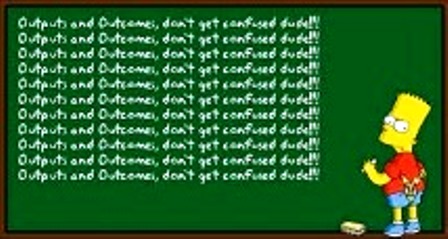
Outputs are those results which are achieved immediately after starting the project:
For example, when seeking funding for a Basic Book-Keeping Course, participants attending an initial workshop would get a clear understanding of the basic principles involved, so this is the Output that the project has achieved right after the first part of the course.
Outcomes would be, for example, when participants have begun to implement these Basic Book-Keeping principles within their organisation
-
Right to Work in the UK
 If you have a new employee coming to work from abroad, you must first check that they have a right to work in the UK before you employ them
You can either:
- check the applicant’s original documents
- check the applicant’s right to work online, if they’ve given you their share code
You could face a civil penalty if you employ an illegal worker and have not carried out a correct right to work check.
There will be no change to the rights and status of EU citizens currently living in the UK until 30 June 2021, or 31 December 2020 if the UK leaves the EU without a deal.
-
Making A Complaint About A Charity
 You can complain to the Charity directly, unless you suspect illegal activity, like terrorism or abuse.
!Contact the police on 101 if you suspect illegal activity!
If you are not happy with how the charity deals with your complaint, contact the relevant regulator:
Fundraising complaints
Contact the Fundraising Regulator to complain about:
- the way you’ve been asked for donations
- how fundraisers have behaved
You can also complain on behalf of someone else.
Advertising complaints
Contact the Advertising Standards Authority to complain about:
- an advertising campaign you think is offensive, deceptive or inaccurate
- the amount of emails or mail you get from a charity
You can change how often you get emails, phone calls, texts or post from a charity using the Fundraising Preference Service.
Other serious complaints
Complain to the Charity Commission if a charity is, for example:
- not doing what it claims to do
- losing lots of money
- harming people
- being used for personal profit or gain
- involved in illegal activity
Make a serious complaint about a charity.
If you’re a Trustee or Auditor
You can:
- report serious concerns to the Charity Commission if you’re a trustee
- report a concern if you’re an auditor
If You’re A Charity Employee Or Volunteer
Read how to report serious wrongdoing at a charity you work for
-
Maternity Leave and Pension Contributions
You and your employer will continue to make pension contributions if you’re getting paid during maternity leave.
The amount you contribute is based on your actual pay during this time, but your employer pays contributions based on the salary you would have received if you were not on leave.
If you’re not getting paid, your employer still has to make pension contributions in the first 26 weeks of your leave (‘Ordinary Maternity Leave’).
Additional Maternity Leave and Pension Contributions
You will need to check your employer’s maternity policy and your contract to find out if you and your employer will have to make pension contributions. Your employer will have to carry on making contributions afterwards if it’s in your contract. If you do stop contributing, your employer will also stop their contributions and you will be treated as a having left the scheme.
If you’re a member of a defined contribution pension scheme, you continue to pay contributions into the scheme while you’re on paid parental leave.
The Pensions Advisory Service can give advice and more detailed information
-
Charity Annual Return – New Questions
 From the Charity Commission
all 2018 and 2019 annual return questions
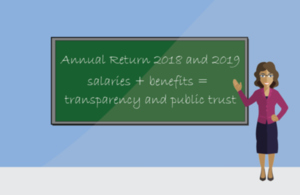
Why we are asking about salaries and benefits in charities
Our research into public trust and confidence in charities shows that the public is concerned about high levels of pay in charities.
Because of this we will be asking charities to provide more information about salaries to increase accountability.
We will ask for a breakdown of salaries across income bands, and the amount of total employee benefits for the highest paid member of staff.
But, in response to concerns raised during our public consultation, we will not publish details of benefits given to the paid member of staff on the charity register.
-
Charity Group AGM sample agenda
 The aim of the AGM is to provide the charity trustees and/or officers the opportunity to explain their management of the charity to the members. It also provides the members of the charity with an opportunity to ask questions before voting on business items on the agenda.
The business that must be considered by the AGM will usually be specified in the governing document or by underlying legislation. However, the charity trustees can include any other additional items of business they feel appropriate.
Specimen notice for an Annual General Meeting for an unincorporated association:
Note: If you use this example, you will need to insert details about your charity and its named personnel, and your particular AGM meeting in the square brackets [] and those named here in red.
[Name of Charity]
Notice of Meeting
NOTICE IS HEREBY GIVEN that the [15th] Annual General Meeting of [Name of Charity] will be held at [insert full address details] at [insert time and date] to transact the following business.
AGENDA [delete as required]
1. Minutes of the previous meeting
To be agreed and matters arising.
2. Reports and accounts
To receive and consider the accounts for the year ended [date] and the reports of the charity trustees and auditors.
3. Auditors
To appoint Messrs Search and Checkit as the auditors.
4. Auditors’ remuneration
To authorise the charity trustees to set the level of the auditors’ fees.
5. Appointment of charity trustees
Please see the attached election addresses for further information about each candidate.
To re-appoint Mr I Dogood for a second period of [insert number] years.
To re-appoint Miss I Could Dobetter for a second period of [insert number] years.
To appoint Mr I M Knowitall as a replacement for Mrs I Mustgo who retires after [insert number] years service.
To confirm the appointment of Mrs G Benevolent who joined the Board on the [insert date] to replace Mr I Movedon.
[Nominations are required for the following officers [insert details] and must be received by [date].]
[Nominations for the position of Trustee must be received by [date].]
[NB details of how to make a nomination are available from the Secretary.]
6. Alteration to the Constitution
To consider and vote upon the following resolution.
That clause [insert details] of the [details of governing document] be amended to read [insert text of resolution].
7. Members proposed resolutions
Details will be given once proposed resolutions are received. Proposed resolutions should be sent to the Secretary by [noon] [14 days prior to the date of the meeting]. A revised agenda will be issued by [7 days prior to the meeting].
8. Any other business
To deal with any matters raised at the meeting.
By order of the Board of charity trustees
[insert name]
Secretary
[insert date of notice]
You can find the online version of this Sample Agenda here
-
When To Claim Gift Aid
 When you must claim
Your deadline to claim Gift Aid depends on how your charity is set up.
You need to claim for a donation within 4 years of the end of the financial period you received it in. This is:
- the tax year (6 April to 5 April) if you’re a trust
- your accounting period if your charity is a community amateur sports club (CASC), a Charity Incorporated Organisation (CIO) or a limited company
You must claim on cash donations under the Gift Aid Small Donations Scheme within 2 years of the end of the tax year that the donations were collected in.
Keeping records
You need to keep records of these donations for a further two years
How to claim
You can claim Gift Aid using Charities Online with:
- eligible software, like a database
- a spreadsheet of your donations
For claims of over 1,000 donations you must use software.
To apply by post use form ChR1, which you can get from the charities helpline.
When you’ll get paid
You’ll get a Gift Aid payment by BACS within:
- 4 weeks if you claimed online
- 5 weeks if you claimed by post using form ChR1
-
Claiming tax back if you stop work
 You can claim a tax refund if you’re not going to work for at least 4 weeks (for example, you’re retired, looking for a job, or returning to study) and you’re not claiming any of these benefits:
- Jobseeker’s Allowance
- taxable Incapacity Benefit
- Employment and Support Allowance
- Carer’s Allowance
You can either:
- use the online service
- fill in form on-screen, print and post to HMRC
To use the online service, you need a Government Gateway user ID and password. If you do not have a user ID you can create one when you use the service.
-
News from DCAS
DCAS staff will be on annual leave next week, so the office will be closed from Monday 9th September to Monday 16th September when the office will be fully staffed again.
Special thanks must go to all of you for continuing to use our service in spite of the lack of funding from Derby City Council
 Following the retirement of our group’s Independent Examiner, Ted Cassidy, our new Independent Examiner will be Pam Rickerby, who enjoys playing badminton in her spare time. Welcome to our group, Pam!
-
Subscribe
Subscribed
Already have a WordPress.com account? Log in now.
 Derby Community Accountancy Service